Zone 2 vs HIIT for longevity: which one actually earns your time?
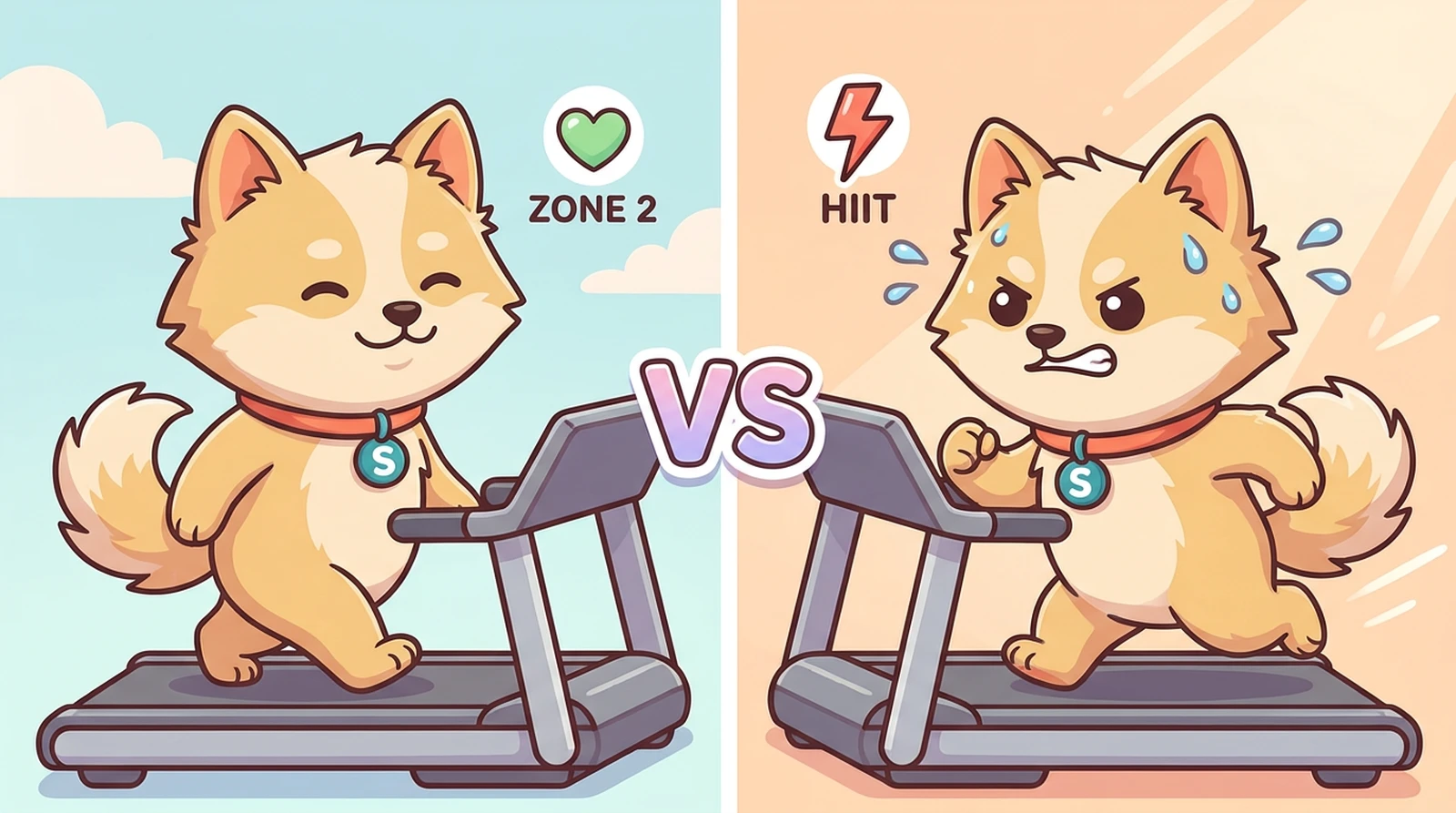
If you could only train your heart one way for the next thirty years, which would you pick: the slow stuff that feels like nothing, or the hard stuff that leaves you on the floor?
It’s a fake question, obviously — nobody’s forcing the choice — but it’s the argument the internet keeps having. One camp says Zone 2 is the foundation of everything and intervals are overhyped. The other says life is short, HIIT is efficient, and shuffling along at conversational pace for an hour is a waste of a perfectly good gym slot. Both camps are half right, which is the least satisfying possible outcome.
So let’s actually settle it. Not “which is better” in the abstract, but which one earns your limited time when the goal is a longer, healthier life — and in what ratio. The short version, so you can leave now if you like: you need both, but most people are already doing the hard stuff and skipping the easy stuff, which is exactly backwards.
What each one actually does
These aren’t two flavours of the same thing. They stress your body through genuinely different doors.
Zone 2 is sustained, low-intensity work — roughly 60-70% of your max heart rate, the pace where you can still hold a conversation but wouldn’t want to recite poetry. The adaptations happen underneath the surface. You build mitochondrial density (more of the little engines in your muscle cells), improve fat oxidation, and get better at clearing lactate before it piles up. Iñigo San-Millán and George Brooks laid a lot of this out in Sports Medicine (2018), tying Zone 2 intensity to metabolic flexibility — your ability to switch cleanly between burning fat and burning carbs. That flexibility is quietly one of the better markers of metabolic health, and it’s the thing sedentary metabolisms lose first.
The catch with Zone 2 is that it’s boring and it takes ages. There’s no way around the ages part — the adaptations scale with time under tension, so the sessions are long by design.
HIIT — high-intensity interval training — is the opposite trade. Short, brutal bursts near your ceiling (85-95% of max heart rate), with recovery between them. The signature longevity protocol is the Norwegian 4x4: four four-minute intervals at 90-95% of max, each followed by three minutes of easy recovery. What it targets is your VO2 max — the maximum oxygen your body can use — and it targets it hard. Helgerud and colleagues showed this cleanly in Medicine & Science in Sports & Exercise (2007): 4x4 intervals improved VO2 max more than an equal volume of moderate continuous training. Per session, intervals win the VO2-max race.
And VO2 max matters enormously, because it’s about the strongest fitness predictor of how long you’ll live — a 2018 JAMA Network Open study of 122,007 patients found no upper limit to the benefit. I’ve taken that study apart properly in the JAMA VO2 max study, dissected, so I won’t relitigate it here — and if you just want to know what a good VO2 max looks like at your age, that’s the other one. The point for now: if VO2 max is the number that matters most, and HIIT moves it most efficiently, why not just do HIIT?
The head-to-head, on the axis that actually matters
Here’s where it gets interesting, because “which raises VO2 max more per session” is the wrong question. The right question is: which can you actually sustain for years without breaking?
Intensity is a stimulus you can only take in small doses. Push hard every session and you don’t get four times the adaptation — you get overreaching, nagging injuries, elevated resting heart rate, and the specific flavour of dread that makes people quit training entirely. HIIT is potent precisely because it’s rare. Try to make it your whole programme and it stops working.
This is why the endurance world keeps landing on polarised training — lots of easy, a little bit very hard, and almost nothing in the moderate middle. Stephen Seiler’s research on elite athletes found they do roughly 80% of their training sessions at low intensity and about 20% at high, and Stöggl and Sperlich confirmed in Frontiers in Physiology (2014) that this polarised distribution produced greater fitness gains than threshold-focused or high-intensity-heavy alternatives. The easy volume isn’t filler around the intervals. It’s the thing that makes the intervals repeatable — it builds the aerobic base, keeps the systemic stress manageable, and lets you show up to the next hard session actually recovered.
Then there’s the part nobody selling interval classes wants to mention: more intensity is not linearly more benefit. The Copenhagen City Heart Study (Schnohr et al., Journal of the American College of Cardiology, 2015) tracked joggers over years and found a U-shaped curve. Light and moderate joggers had the lowest mortality. Strenuous joggers — the ones going hard, often — had mortality rates statistically indistinguishable from people who didn’t jog at all. Let that sink in: at the high end, the extra suffering bought nothing. The dose-response curve for exercise intensity bends, and past a point it bends the wrong way.
So the head-to-head verdict isn’t “HIIT wins because VO2 max.” It’s that HIIT is a concentrated stimulus you ration, and Zone 2 is the volume you build on. They’re not competitors. One is the espresso shot; the other is the meal.
But what about time? HIIT is more efficient
This is the strongest argument for intervals, and it’s a fair one. If you have three hours a week, four minutes of 4x4 buys more VO2 max than four minutes of walking. For genuinely time-crunched people, a couple of short high-intensity sessions is vastly better than nothing, and I’d never talk anyone out of them.
But “efficient per minute” quietly assumes VO2 max is the only prize. It isn’t. Zone 2 delivers the metabolic adaptations — fat oxidation, mitochondrial density, insulin sensitivity, lactate clearance — that intervals largely don’t, at least not to the same degree. You can’t interval your way to metabolic flexibility. And crucially, an all-HIIT programme has nowhere to put recovery. Zone 2 is active recovery that still counts as training. Strip it out and your only options are hard or nothing, which is how people end up either injured or on the sofa.
The Generation 100 study is worth sitting with here. Stensvold and colleagues (BMJ, 2020) randomised over 1,500 Norwegian adults aged 70-77 to five years of either high-intensity intervals or moderate continuous training. The headline that got shared was “HIIT group had the lowest mortality” — 3% versus around 5-6% — but the honest reading is that the differences between groups weren’t statistically significant. VO2 peak improved a bit more in the HIIT arm, but everyone who moved did well. The signal from five years of data isn’t “intervals beat easy cardio.” It’s “consistent cardiovascular training, of either kind, in your seventies, is doing you a great deal of good.” Which is a more useful conclusion than the headline, and a less clickable one.
Who should pick which
Since it’s not either/or, “picking” mostly means picking a ratio and a starting point.
- If you’re currently doing nothing: start with Zone 2. Long walks that leave you slightly breathless count — a brisk uphill walk hits Zone 2 for most untrained people. Build the habit and the base for a few weeks before you add anything hard. Early on, almost any cardio raises VO2 max anyway, so you’re not missing out by starting easy.
- If you already train hard and often (the CrossFit / spin-class / “if I’m not dying it doesn’t count” crowd): you’re the person the Copenhagen curve is talking to. Add Zone 2 and — genuinely — take some intensity out. More easy volume, fewer all-out days. Your resting heart rate and your knees will both thank you.
- If you’re time-crunched and can only do two or three short sessions: keep one as a proper hard interval session and make the others easy. Even a compressed week benefits from the polarised shape.
- If you’re over 70 or managing a health condition: the Generation 100 and Rognmo (Circulation, 2012) data are reassuring on interval safety, but get clearance and start supervised. Age isn’t a reason to avoid intensity; it’s a reason to ramp into it sensibly.
The verdict
Zone 2 versus HIIT is a false fight. The evidence — polarised-training research, the Copenhagen U-curve, the metabolic story on one side and the VO2-max story on the other — all points to the same unglamorous conclusion: do both, with easy work dominating — about four easy sessions for every hard one (the polarised ~80/20 split, counted by sessions). In practice that’s three to four Zone 2 sessions of 45-90 minutes plus one high-intensity session a week. The intervals move the number most tied to survival; the easy volume is what lets you keep doing the intervals without falling apart.
If I had to name the single most common mistake, it’s not “people do too much Zone 2.” Nobody’s overdosing on easy cardio. It’s that people skip the base entirely, go hard every session because hard feels productive, and then wonder why they’re perpetually a bit broken. The boring stuff is the part most of us are missing. For the full case on why the least dramatic training does the most, the Zone 2 deep dive is the companion to this one — and if you want to see where both fit into the wider picture, the four-pillar training framework puts cardio next to the strength and recovery work it’s supposed to sit alongside.
So: not which one. How much of each. And for most people, the honest answer is more of the easy one than your ego would like.
Related posts
Zone 2 cardio: the slightly boring training that actually works
Zone 2 is the lowest-glamour, highest-impact training for longevity. Here's what it actually is, why …
VO2 Max: Why Cardiorespiratory Fitness Is the Strongest Predictor of Longevity
VO2 max is the fitness number most tied to how long you live. What it is, what counts as a good score for your …
The Four Pillars of Longevity Training: A Science-Backed Framework
Zone 2 cardio, strength, VO2 Max intervals and stability — the four pillars of longevity training, and how …
What's your biological age?
Reading about longevity is step one. Knowing your number is step two — a free 2-minute test, no signup.
Check your biological age →