I measured my biological age five ways in one week: the answers were 14 years apart
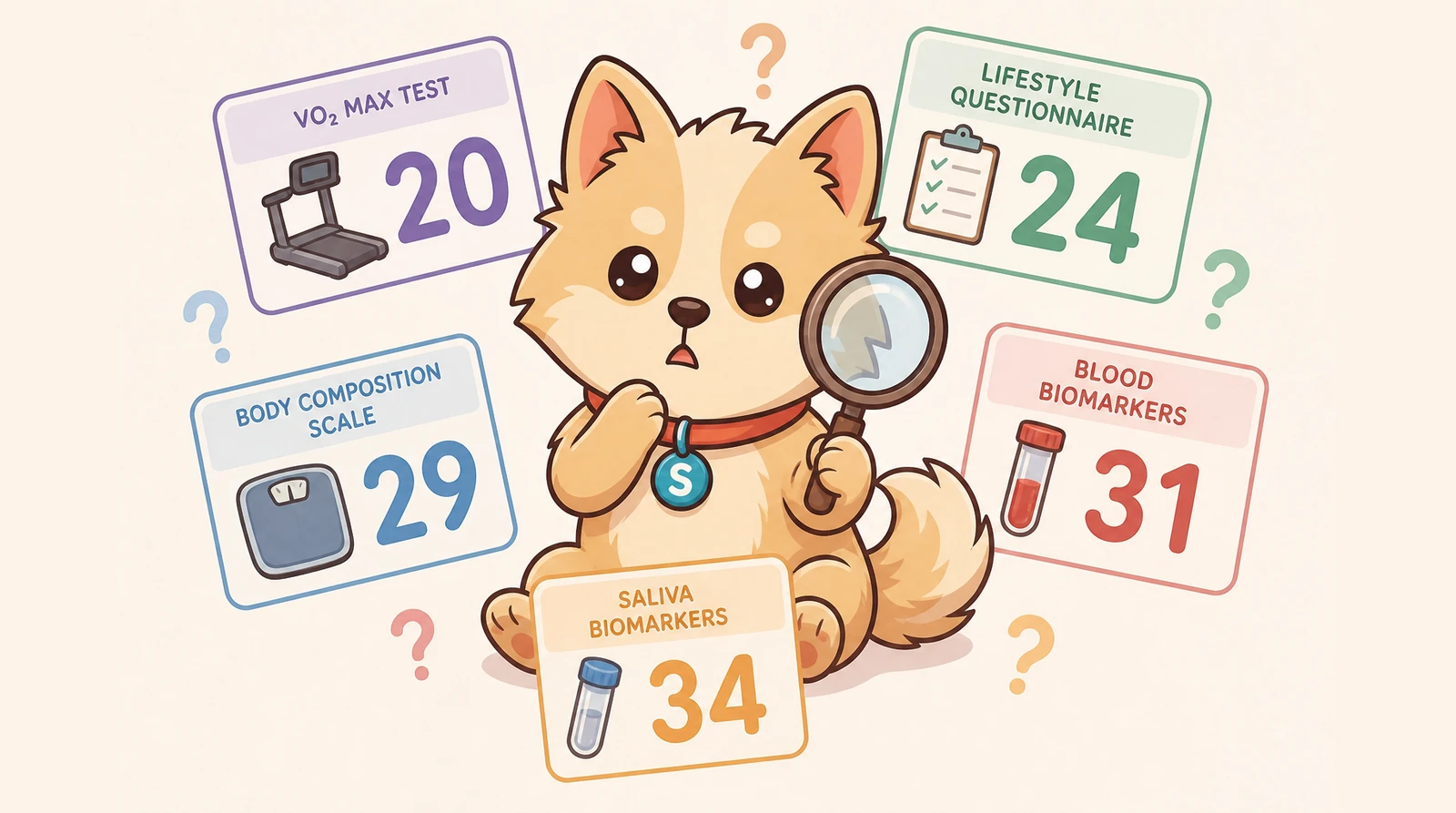
Five tests. One body. One week. The answers came back as 20, 24, 29, 31 and 34.
I am 26.
That’s a fourteen-year spread from a single person who did not, at any point during the week, actually age. My first instinct was the obvious one — four of these are wrong, find the good one — and I spent about two days on that theory before working out it was the wrong question entirely.
Here’s what I think now, which is the argument of this post: the five numbers disagreed by fourteen years because they were built to answer different questions, and once you sort them by question rather than by accuracy, most of the disagreement stops being noise and starts being information.
The remaining bit genuinely is noise. I’ll show you how much.
What I actually did, and what to hold loosely
Over six days I took:
- Our own free biological age quiz — a questionnaire. I work at Sarvita, so declare that bias where you like.
- A fitness age derived from a measured VO2 max at a sports lab, on a treadmill, with a mask on.
- A phenotypic age calculated from a routine blood panel using Levine’s published nine-marker formula.
- A consumer methylation kit — saliva tube, prepaid envelope, roughly €300, three-week wait.
- A “body age” from the bathroom scale, which is to say bioimpedance and a formula nobody publishes.
Before anything else: this is one person, one week, consumer-grade instruments, no repeat measurements on any test. It is an anecdote about five tests, not a study about me. Where I quote a number below it’s my result as reported to me, rounded, and I’d hold every one of them loosely — including, especially, the flattering one.
The five numbers
| Test | What it returned | Gap vs my actual age |
|---|---|---|
| Fitness age (measured VO2 max) | 20 | −6 |
| Sarvita questionnaire | 24 | −2 |
| Body composition “body age” | 29 | +3 |
| Phenotypic age (blood panel) | 31 | +5 |
| Methylation kit (saliva) | 34 | +8 |
The ordering is the interesting part, and I’d guess it’s the same ordering most reasonably fit people in their twenties get: the function tests flatter you, the molecular tests don’t, and the questionnaire lands wherever your habits sit.
I’d love to tell you I received these with detached scientific calm. In practice I read the 20 out loud to my flatmate and then didn’t mention the 34 for four days.
Four questions wearing the same word
The word “age” is doing an enormous amount of work here, and it’s hiding the fact that these tests were commissioned to answer different questions.
How well do I function right now? That’s the fitness age. Cardiorespiratory fitness is a performance test — your heart, lungs and mitochondria doing their actual job under load — and it’s the single measure with the most convincing mortality data behind it, which is why we made it the strongest predictor of longevity rather than one of many.
How much damage am I carrying? That’s the blood panel. Levine’s phenotypic age takes nine routine markers — albumin, creatinine, glucose, C-reactive protein, lymphocyte percentage, mean cell volume, red cell distribution width, alkaline phosphatase and white cell count — plus your chronological age, and returns the age of the average person with your mortality risk. (According to PubMed: Levine et al., Aging, 2018, DOI.) It is essentially an inflammation-and-organ-stress snapshot with a birthday attached.
How do my habits compare to everyone else’s? That’s the questionnaire, ours included. It doesn’t measure anything. It ranks you against population averages using inputs — usual walking pace, activity, self-rated health — that happen to be strong predictors. Useful as a map of which system to look at first, useless as a tracker, because the number only moves when you change an answer.
How fast am I aging? And here is the one I got wrong, which is embarrassing, because it’s the question I spent €300 trying to answer. I assumed a methylation kit bought me a rate — the speed I’m ageing at. It doesn’t. Mine returned an age: 34. That’s a state estimate, the same kind of quantity as the blood panel, reached through a different substrate.
The rate question is real and there is a real instrument for it. DunedinPACE reports biological years accrued per calendar year, derived from two decades of longitudinal measurement in the Dunedin birth cohort. (According to PubMed: Belsky et al., eLife, 2022, DOI.) A state and a rate are not comparable quantities — you can’t average them any more than you can average a distance and a speed. But I didn’t buy one, so nothing in that table answers this. The question I most wanted answered is the one I never tested for.
Nor can I tell you which question the 34 does answer, because the provider wouldn’t name its clock when I asked. If it’s a first-generation clock — Horvath’s, say, trained to predict chronological age in the first place (Genome Biology, 2013, DOI) — then it’s running a fidelity check: does my methylome look my age? If it’s a second-generation clock trained on mortality, it’s answering the damage question, which my blood panel already answered rather more cheaply. Two quite different jobs, one number, no label.
And then there’s the scale, which answers no question at all. Its “body age” is an undisclosed function of an impedance reading. I include it because most people’s first biological age number comes from a scale like mine, and it deserves saying plainly: a number with no published formula and no validation isn’t a bad measurement, it’s not a measurement.
So: four questions the word “age” is doing duty for, three of them actually answered by something in my table, one instrument that answers nothing, and one whose question the seller declined to specify. Already the fourteen-year spread looks less like five instruments failing and more like five instruments being asked to line up when they were never built to.
How much of fourteen years can I actually defend?
Now the part I found genuinely useful, which is working out how much of that spread survives scrutiny. Take the two ends.
The 20 is a floor, not a result. The fitness-age scales in common use are built on the HUNT cohort’s non-exercise VO2peak model (Nes and colleagues, Medicine & Science in Sports & Exercise, 2011), and the one I used doesn’t report below 20. Which means my number isn’t “twenty” — it’s “off the bottom of the scale”, and I have no idea by how much. That’s a boundary artefact dressed as a measurement, and it’s the reason I’d never track fitness age itself. Track the VO2 max underneath it, which has no floor and moves in millilitres.
The 34 carries an error bar the report didn’t print. Higgins-Chen and colleagues took samples, split them, and ran conventional clocks on the technical replicates — the same biological material, processed twice. Deviations reached about nine years. (According to PubMed: Higgins-Chen et al., Nature Aging, 2022, DOI.)
I want to be careful about what that licenses, because the tempting version of the argument is one I can’t actually make. It does not mean my 34 is noise. A gap between a clock’s output and your birthday can hold real biological signal, real measurement error, or — most likely — some of each, and a replicate study can’t tell you the mix for any individual result. What it establishes is the width of the uncertainty: on a conventional clock, one reading can sit years away from where a second run of the same sample would land. And because my provider wouldn’t name its clock, I can’t even confirm that figure applies to mine. I’m left holding a number I can’t place an error bar on, from a test that wouldn’t tell me what it was measuring.
The 31 is where I got the arithmetic wrong, and I’ll own it because I believed the wrong version for a bit. I’d had a cold the week I gave blood, and my first thought was: CRP goes up tenfold with an infection, CRP is in the formula, therefore the 31 is meaningless. Except CRP enters Levine’s model logged, which flattens a tenfold rise into something much smaller — the formula is built precisely so one twitchy marker can’t run away with the result. A cold does not add five years.
What the cold does do is more insidious. The formula has no way to tell a fortnight of infection from a decade of low-grade inflammaging — both look like elevated CRP. The number wasn’t inflated much. It was ambiguous, which is worse, because it looks exactly as confident as a clean result. I should have drawn blood when I was well, or drawn it twice.
So: fourteen years is an upper bound, and it’s assembled largely from the two results I can defend least — a scale floor at one end, an undisclosed uncertainty at the other. Take those at face value and you get fourteen. Set them aside and the remaining three span seven. Whether the honest figure sits nearer seven or nearer fourteen, I can’t tell you, and no amount of staring at the report will fix that.
That sounds like a failure to reach a conclusion. I’ve come round to thinking it is the conclusion. The two tests I’d been most impressed by walking in — the lab treadmill and the €300 kit — turned out to be the two I could say least about walking out, and not because they’re bad science. Because one reports on a scale with a floor and the other won’t tell you what it measured. Neither of those is visible on the result page.
What the spread actually told me
Here’s the read I’d have missed if I’d gone looking for the one true number.
My function tests came back well ahead of my chronological age. My damage tests came back behind it. That is not a contradiction to be resolved — it’s a finding: my cardiovascular fitness is running ahead of my inflammatory and metabolic markers. Same body, two systems, different trajectories. And it tells me exactly where the next bit of effort goes, which is not more Zone 2.
That’s the case for taking several tests rather than the best one. Not to average them into a single flattering figure — please don’t — but because the pattern of disagreement is a rough map of which system is aging you fastest. A person whose fitness age is high and whose blood panel is pristine has a completely different problem to mine, and a single composite number would hide both of us.
It’s also why we ranked biological age tests by how much to trust them rather than by which returns the lowest number, and why the underlying biomarkers ranked by mortality prediction are a better shopping list than any kit’s marketing page.
The four things I got wrong
1. I took every test exactly once. For the two tests with known reliability problems, a single reading is close to uninterpretable. Two saliva kits three weeks apart would have cost me another €300 and told me more than the first one did, because I’d have seen the noise directly instead of citing someone else’s estimate of it.
2. I gave blood while ill. Entirely avoidable. One week’s patience.
3. I did it at 26. These tests are far better at detecting change within one person than at placing that person against a population, and at my age there’s very little to place. The genuinely valuable thing I got out of the week wasn’t any of the five numbers — it was a dated baseline for a version of me that will be much more interesting to compare against at 40.
4. I let the cheapest, best-evidenced test be the one I didn’t repeat. The two-minute physical — grip, gait speed, a ten-second one-leg stand — costs nothing, has real mortality data behind it, and I did it once, casually, in the kitchen. That’s precisely backwards. The free test with small measurement error is the one you should be doing every quarter; the €300 test with a nine-year error bar is the one you take once and file.
Would I do it again?
Not all five. Once was enough to learn what each of them is for, and that was the point.
What I’ve kept is one function test and one damage test, on different clocks: VO2 max quarterly, because it responds to training inside twelve weeks and has no floor; a full blood panel annually, taken when I’m demonstrably well, because that’s the pace at which it can actually move. The scale still reports a body age. I’ve stopped looking at it.
The methylation kit sits in a drawer with its 34, and I’ll retake it at 30 out of curiosity rather than diligence. It’s a genuinely impressive piece of science that is being sold for a job it can’t quite do yet — telling one individual whether they had a good year. If you’d like the longer version of that argument, what biological age actually means covers the ground properly.
Anyway. If you take one thing from a week of being told five different ages by five different machines, make it this: stop asking which number is right. Ask what question each one was built to answer, then pick the question you actually care about and track that test, the same way, for years.
The number matters far less than the slope.
Related posts
Biological age tests, ranked by how much you should trust them
Methylation kit, blood panel, or a stopwatch and a wall? Nine ways to measure biological age, ranked by …
What Is Biological Age and Why It Matters More Than Your Birthday
Chronological age counts years since birth; biological age measures how well your body is actually aging — and …
Longevity biomarkers, ranked by how well they actually predict death
Not all longevity metrics are equal. VO2 max, grip strength and walking pace predict who dies far better than …
What's your biological age?
Reading about longevity is step one. Knowing your number is step two — a free 2-minute test, no signup.
Check your biological age →