The DO-HEALTH trial, dissected: what vitamin D, omega-3 and strength training actually did
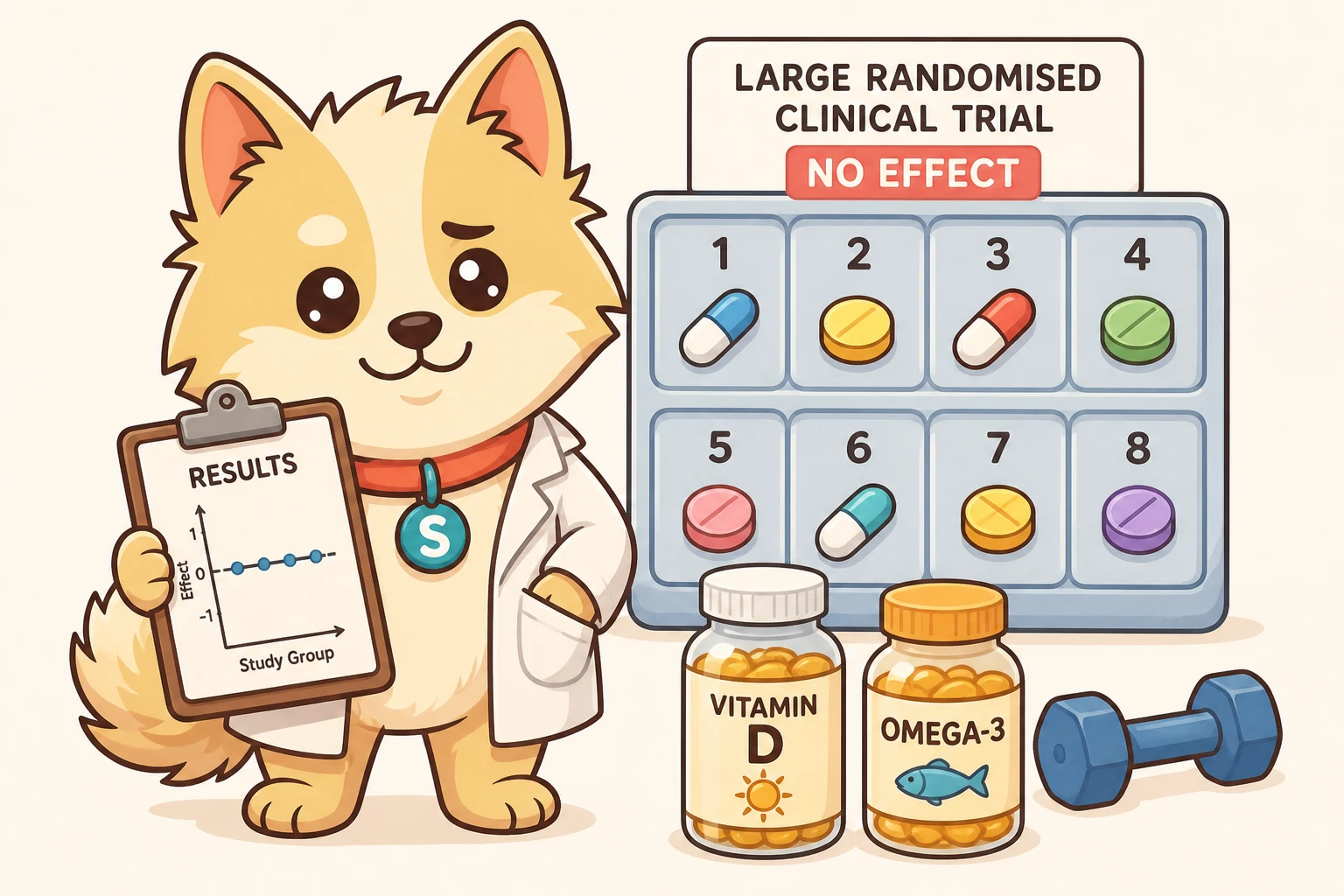
Two thousand one hundred and fifty-seven people over the age of 70 spent three years taking daily pills — some real, some placebo, nobody knowing which — and doing a home exercise programme, randomised across eight different combinations in five European countries. It cost millions and ran from 2012 to 2017. And the headline result was: nothing. Not one of the six primary outcomes moved.
That study is DO-HEALTH, published in JAMA in 2020, and it is one of the most useful longevity trials ever run — precisely because it failed. Most of what you read about vitamin D, omega-3 and strength training for healthy ageing leans on observational data, where healthy people who take supplements are compared with less healthy people who don’t. DO-HEALTH is the rare case where someone put the whole standard-issue longevity starter pack into a randomised trial and let it fall over in public.
It’s also the study most likely to be quoted at you in two opposite directions — “supplements do nothing” and “the combination cut cancer risk by 61%” — both from the same trial. So let’s take it apart properly.
If you want the plain-English version of what each nutrient does, I’ve written those separately: vitamin D and longevity and omega-3 fatty acids and longevity. This post is about the trial itself, and what a null result is actually evidence of.
Why this study matters
Longevity research has a structural problem: the interventions people care about most are cheap, over-the-counter, and therefore under-funded. Nobody makes money proving that 2,000 IU of vitamin D3 does or doesn’t prevent fractures. So the field runs on cohort studies, where the confounding is severe — people who take supplements and do strength training also tend to sleep, eat and earn differently.
DO-HEALTH is the antidote to that, and its design is genuinely clever. Instead of testing one thing, it used a 2×2×2 factorial structure: every participant was randomised to receive or not receive each of three interventions, producing eight groups. That means you get a read on each intervention individually and on every combination, from one trial and one budget. Testing all three separately would have cost three times as much and still told you nothing about whether they work better together.
The three interventions were, deliberately, the boring consensus ones. Not rapamycin. Not NAD precursors. The things a sensible GP would suggest.
The design: who, how many, what they measured
Heike Bischoff-Ferrari and colleagues, led out of Zurich, recruited 2,157 adults aged 70 or over between December 2012 and November 2014, with final follow-up in November 2017. Median follow-up was 2.99 years, and 1,900 of them — 88% — completed the study, which is an excellent retention figure for a three-year trial in this age group. (According to PubMed: Bischoff-Ferrari et al., JAMA 2020, DOI.)
Participants were randomised into one of eight groups combining:
- Vitamin D3 — 2,000 IU/day, or matching placebo
- Marine omega-3s — 1 g/day, or matching placebo
- A simple home strength exercise programme (SHEP) — 3 × 30 minutes a week, or a control exercise programme
That last comparator is the design detail most summaries drop, and it matters enormously. The exercise arm was not compared with sitting still. It was compared with another home programme, done at the same frequency — a flexibility-based control. So the trial asked “does strength training beat gentle movement?”, not “does strength training beat nothing?” Those are extremely different questions, and only one of them is the question most readers assume was answered.
The six primary outcomes were change in systolic blood pressure, change in diastolic blood pressure, the Short Physical Performance Battery (SPPB, a walk-balance-chair-rise test), the Montreal Cognitive Assessment (MoCA), the incidence rate of non-vertebral fractures, and the incidence rate of infections.
Because there were six of them, the authors did something admirably strict: they pre-specified 99% confidence intervals and a p<0.01 threshold for significance, rather than the usual 95% and 0.05. Six chances to find something means a higher chance one turns up by luck, and they built the correction in from the start. Hold onto that. It becomes the whole story later.
What they found
Nothing cleared the bar. Not one intervention, alone or in combination, on any of the six outcomes.
To give a sense of the size of the non-effect rather than just the verdict:
- Systolic blood pressure: vitamin D vs no vitamin D, and omega-3 vs no omega-3, both produced a mean change difference of -0.8 mmHg (99% CI -2.1 to 0.5). That’s not a “we couldn’t detect it” result — it’s an estimate of roughly nothing, with a tight interval around it.
- Diastolic blood pressure: omega-3 managed -0.5 mmHg (99% CI -1.2 to 0.2).
- Infections: omega-3 came closest, with an incidence-rate ratio of 0.89 (99% CI 0.78–1.01, p=0.02) — an 11% relative reduction that missed the pre-specified p<0.01 threshold. It would have been “significant” under the conventional 0.05 rule. It wasn’t under theirs.
- SPPB, MoCA and non-vertebral fractures: no effects at all.
And the number that reframes everything: 25 deaths, in 2,157 people, over three years. Similar across all treatment groups.
The caveat that reframes the whole trial
Twenty-five deaths out of 2,157 people whose mean age was 74.9 is a mortality rate of about 1.2% over three years. For context, that is a dramatically healthier group of 75-year-olds than the general population of 75-year-olds. And that’s by design: the entry criteria required no major health events in the five years before enrolment, sufficient mobility, and intact cognitive function.
Look at what else that produced. At baseline, 82.5% of participants were already at least moderately physically active. Their gait speed was solid. Their cognition was intact. And then we asked whether 30 minutes of home strength work, three times a week, would improve their walk-balance-chair-rise score relative to a flexibility programme, over three years.
That is a very small gap to close. And this is the thing I’d want anyone quoting DO-HEALTH to sit with:
A null result in a healthy population is evidence about the population as much as about the intervention.
You cannot demonstrate improvement in people who have very little room to improve. The technical name is a ceiling effect; the useful version is the headroom rule — the size of the benefit an intervention can deliver is capped by the size of the deficit it corrects. Give vitamin D to someone deficient and you’re correcting a deficit. Give it to someone adequate and you’re topping up a full tank.
Here’s where I have to argue against my own framing, though, because the data doesn’t let the headroom rule off entirely. At baseline, 40.7% of participants had 25(OH)D below 20 ng/mL — which is not a replete population by most clinical standards. So the trial wasn’t only topping up full tanks: four in ten arrived with a genuine deficit, and randomisation means roughly half of those spent three years on 2,000 IU a day. The overall vitamin D contrast was still flat.
Be careful about how far that stretches, though, because it’s the sort of inference that’s easy to overrun. What the trial reports is the aggregate vitamin-D-versus-placebo comparison across everyone. It is not a subgroup estimate showing that the deficient participants specifically got nothing — that would need the treatment effect calculated within that subgroup, which isn’t what the primary paper presents. What you can fairly say is that a cohort containing plenty of genuine deficiency, dosed for three years, produced no detectable trial-wide benefit on blood pressure, physical function, cognition, fractures or infections. That’s a harder null to wave away than a pure ceiling effect would be. The headroom rule explains the exercise result well and the vitamin D result only partly.
The sequels: where the positive headlines came from
DO-HEALTH’s primary paper is a null. Its afterlife is not, because the trial generated a rich dataset that has since produced a steady stream of secondary analyses — and those are where the flattering numbers live.
Cancer. A pre-defined exploratory analysis in Frontiers in Aging (2022) found that all three treatments combined were associated with a hazard ratio of 0.39 (95% CI 0.18–0.85) for invasive cancer. That’s the “61% reduction” you’ve seen. It rests on 4 cases in the combined group versus 12 in controls. Each pair of treatments also looked good — omega-3 plus exercise at 0.52, omega-3 plus vitamin D at 0.53 — but each individual treatment on its own missed significance. (According to PubMed: Bischoff-Ferrari et al., DOI.)
Pre-frailty. In the 1,137 participants who were robust at baseline, all three treatments combined reduced the odds of becoming pre-frail over three years (OR 0.61, 95% CI 0.38–0.98, p=0.04), per the Journal of Frailty & Aging (2023). No individual treatment did. No effect on actual frailty. (According to PubMed: Gagesch et al., DOI.)
Biological ageing. A post-hoc analysis of 777 participants in Nature Aging (2025) found omega-3 alone slowed three DNA-methylation clocks — PhenoAge, GrimAge2 and DunedinPACE — with all three treatments showing additive benefit on PhenoAge. Standardised effects ran 0.16 to 0.32 units, which the authors translate as 2.9 to 3.8 months of biological age over three years. (If the clock terminology is new, what biological age actually measures is the primer. According to PubMed: Bischoff-Ferrari et al., DOI.)
Vertebral fractures. In JBMR (2025), across 1,488 participants with spine imaging, neither supplement reduced vertebral fracture rates — but the strength programme reduced fracture progressions (IRR 0.34, 95% CI 0.16–0.75) and total vertebral fractures in women (IRR 0.52, 95% CI 0.28–0.98). (According to PubMed: Kistler-Fischbacher et al., DOI.)
Cardiovascular. And one squarely unflattering result, from the Journal of Nutrition, Health & Aging (2024): omega-3 raised HDL (+0.08 mmol/L) and lowered triglycerides (-0.08), but also raised total cholesterol (+0.15), LDL (+0.11) and non-HDL cholesterol (+0.07). Major cardiovascular events: no benefit from anything (omega-3 aHR 1.00, vitamin D 1.37, exercise 1.18). (According to PubMed: Gaengler et al., DOI.)
How to grade a secondary finding
Right, so this is the part I actually think is worth your time, because it generalises well beyond this trial. When the primary outcome is null and a secondary outcome is positive, how much should you believe the secondary?
Note first the quiet asymmetry: the primary analysis held itself to 99% confidence intervals and p<0.01, because six outcomes meant six chances to get lucky. The secondary papers report 95% intervals and p<0.05 — across dozens of further analyses in a dataset that has now been sliced many times over. The same trial applies a strict standard to the result it pre-registered and a loose one to the results it went looking for afterwards. That’s not misconduct; it’s completely normal practice. But it means the two sets of numbers are not the same currency, and shouldn’t be read as if they were.
The rough scoring I use:
- Count the events, not the percentage. A hazard ratio of 0.39 built on 4 versus 12 cases is a percentage sitting on sixteen events. Any three of those cases landing differently moves the number enormously — which is exactly what a confidence interval reaching 0.85 is telling you.
- Was it pre-defined or post-hoc? The cancer analysis was pre-defined and exploratory — better. The methylation-clock analysis was explicitly post-hoc — weaker, though not worthless.
- How many comparisons were in the same family? A 2×2×2 design gives seven treatment contrasts per outcome. If you test all seven and one hits p=0.04, that’s roughly what chance alone predicts.
- Is the finding internally consistent? This is where the omega-3 result earns some genuine credit. It slowed three different methylation clocks in the same direction, showed dose-additivity with the other two treatments, and came closest of anything to hitting the infection endpoint in the primary paper. A single lucky subgroup doesn’t usually behave that coherently. Being wrong in the same direction four times is harder than being wrong once.
- Does the surrogate connect to the outcome? Methylation clocks predict mortality in cohorts. Whether changing the clock changes the outcome is unproven — the same soft joint that undermines most biomarker-based longevity claims.
Applying that, my honest scoreboard: the cancer signal is a hypothesis deserving a dedicated trial, and nothing more. The pre-frailty finding is thin. The omega-3 methylation result is the most credible thing to come out of DO-HEALTH’s afterlife — small, consistent, and still a surrogate. The strength-training effect on vertebral fracture progression is modest but mechanistically sensible, since loading bone is how bone gets stronger.
What it actually means for you
The thesis, plainly: DO-HEALTH is the best randomised evidence we have that the standard supplement-plus-home-exercise stack adds very little to an already-healthy, already-active 70-year-old — and its null result is a statement about how little headroom that person has, not proof that the interventions are inert.
Which turns into a decision framework I’d actually use:
- Fix deficits, don’t top up adequacy. If your vitamin D is genuinely low, correcting it is worth doing for bone and muscle reasons. If it’s adequate, DO-HEALTH says more won’t buy you blood pressure, cognition or fewer fractures. The same logic runs through everything: the return on an intervention scales with the size of the gap it closes.
- Don’t read “beats flexibility exercise” as “beats nothing.” The strength arm’s honest result is that 90 minutes a week of home strength work didn’t outperform an active control in already-active people over three years. That is not an argument against resistance training — it’s an argument that the comparison was between two decent options, and the well-established case for maintaining muscle mass as you age rests on much more than this trial.
- Treat combination claims with extra suspicion. The most impressive DO-HEALTH numbers all come from three-treatment combinations, which is also where the event counts get smallest and the comparisons most numerous. That combination of “most dramatic” and “least data” should always make your eyebrow go up.
- Notice the trade-offs nobody mentions. Omega-3 improved triglycerides and HDL and raised LDL. That’s a mixed result, not a clean win, and it appears in almost none of the popular coverage of this trial.
- Prefer interventions with hard endpoints. The contrast with the 122,000-patient VO2 max study is instructive: that one is observational and can’t prove causation, but it measured death. DO-HEALTH is randomised and measures blood pressure, test scores and methylation clocks. Neither design gives you everything. Knowing which weakness you’re accepting is most of the skill.
Genuinely, my favourite thing about this trial is how boring the honest conclusion is. Three years, eight groups, five countries, one of the best-run trials in the field — and it says that in reasonably healthy older people, the supplement stack doesn’t move the needle, and that the interesting signals are small, surrogate-based, and unconfirmed.
Bit anticlimactic. But a well-run null result tells you more than a badly-run positive one, and there are far more of the latter about.
Related posts
Vitamin D and longevity: what your levels are doing to how you age
Around 40% of Europeans are vitamin D deficient — and most don't know it. Here's what the research shows about …
Omega-3 fatty acids and longevity: what the evidence actually says
Omega-3s reduce chronic inflammation, slow telomere shortening, and cut cardiovascular mortality. Here's what …
The 2018 JAMA VO2 max study, dissected: what 122,000 patients actually showed
The 2018 JAMA study everyone cites for 'fitness predicts survival' — taken apart properly. What 122,007 …
What's your biological age?
Reading about longevity is step one. Knowing your number is step two — a free 2-minute test, no signup.
Check your biological age →